November 2005 Archives

O'Reilly: "Every company in America should be o ... [Media Matters]


O'REILLY: What's happened is frightening. A legal assault by the ACLU [American Civil Liberties Union] combined with the media that blatantly promotes secularism has succeeded in convincing some Americans that the words 'Merry Christmas' are inappropriate while celebrating the national holiday of Christmas.

This, of course, is nuts. Anyone offended by the words 'Merry Christmas' has problems not even St. Nicholas could solve.

Every company in America should be on its knees thanking Jesus for being born. Without Christmas, most American businesses would be far less profitable; more than enough reason for businesses to be screaming Merry Christmas.

Here's the
Video provided by Media Matters

Now there's a novel idea (really, not so novel....it's been almost implied for eons) : that Jesus was born in order to generate business. There's the gospel according to O'Reilly, and the "apostles" of the airwaves that pollute Christian Faith with unabashed consumerism/Americanism/free-marketism.

School Pictures

| | Comments (0) | TrackBacks (0)

My two young'uns, Brian (16) and Kelli (7)
Brian_Kelli_2005bg.jpg

Listen Mr W

| | Comments (0)

Juan Cole on George's illusions about being remmebered fondly as a "war president"

Informed Comment

Let me finish with a word to W. As for your legacy two decades from now, George, let me clue you in on something--as a historian. In 20 years no Iraqis will have you on their minds one way or another. Do you think anyone in Egypt or Israel is still grateful to Jimmy Carter for helping bring to an end the cycle of Egyptian-Israeli wars? Jimmy Carter powerfully affected the destinies of all Egyptians and Israelis in that key way. Most people in both countries have probably never heard of him, and certainly no one talks about the first Camp David Accords anymore except as a dry historical subject. The US pro-Israel lobby is so ungrateful that they curse Carter roundly for all the help he gave Israel. Human beings don't have good memories for these things, which is why we have to have professional historians, a handful of people who are obsessed with the subject. And I guarantee you, George, that historians are going to be unkind to you. You went into a major war over a non-existent nuclear weapons program. Presidents' reputations don't survive things like that. Historians are creatures of documents and precision. A wild exaggeration with serious consequences is against everything they stand for as a profession. So forget about history and destiny and the divine will. You are at the helm of the Exxon Valdez and it is headed for the shoals. You can't afford to daydream about future decades.

Referring to an interview with Seymour Hersh by Wolf Blitzer

Hersh goes on to tell Blitzer that Bush disparages any information about Iraq that does not fit his preconceived notions, and that he feels he has a (perhaps divine) mission to bring democracy to the country. Hersh's inside sources paint a president who is detached and in the grip of profound utopian delusions, which Hersh charitably characterizes as "idealistic."

Ruined

| | Comments (0)

Finding Our Opposites

| | Comments (0)

Finding those who are our so called "opposites," and talking about spiritual things, can feel even more intimidating. Basically we get tripped up by fear. We fear seeming arrogant and disrespectful. We fear being ridiculed. We fear being swallowed up by the pain of seeing so directly into the dismal face of poverty or privilege. We fear being paralyzed by our guilt over the discrepancies between us. These fears are legitimate and need to be felt. And then we must go anyway.

Our guiding question will be, where would Jesus go? Most of these places will be where the privileged and connected are the ones on the outside.

Look around your town or county. Where are people struggling for a better life? Where have people been abandoned? Where is the church absent? Find these places and go there. Don't go there to serve anyone. Don't volunteer to answer the phone or organize a clothing drive or teach reading or fix a meal. Don't do anything. Be. That's all. Learn how to hang out with people who are not like you. Hear their stories, and share something of yours. Be in the tension of not knowing for sure what to say or do. Relax and receive whatever God wants to give you. Learn to be present.

We will not be able to be the church that God intends if we don't let God plant in us, very simply, a passion for people. Not a coercive, codepenclent "love that's not love," but true affection that desires nothing else than to be there, and to be real. Crowds gathered around Jesus because he was available, and he was genuine. Who he was with them was who he was within himself. Are we living true to our inner selves? Are we the kind of people others enjoy being around? Do our schedules allow "hanging out time," and do we hang out where destitute, lonely people hang out?

This from my "Authentic Church" post Sunday is the place where I find myself, and often have, when I allow myself to really reflect on it, over the past 4 years (and probably even longer). I'd say that I have most often found myself here over the past 30 years, since my first exposure to the embodiment of church represented in The Church of the Saviour.

Movable Theoblogical: Finding Others

The compelling desire to be with others in more authentic ways, ways that will foster diversity and reconciliation and help us to act for justice, often presses in on us long before we find others who share that desire. We can feel very alone. We long for something more, but don't know how to find others who might be willing to step out into new structures and processes with us.

You might be wondering where to start. That's easy: start where you are. Let the new way begin in you.

We can't expect others to internalize what we have not yet internalized ourselves. The first "other" we must be reconciled to is our own self. Our true self in Christ waits to know and be known by us.

I am in a place where I don't feel at all that I am the sort of person that anyone would want to be on a journey with. As I have gotten older, I feel less and less like someone who others want to have around. And I feel less and less patient, more frustrated with the direction of things; more restless about how far the church is straying, and the seeming lack of an alternative which offers a hope of turning things around.

I'm determined, though, to seek out the other hidden malcontents; others who have been "ruined" as Gordon Cosby said it; "ruined" by exposure to a vision of church that will not let me satisfied with anything less; particularly with church that doesn't help me AT ALL to battle my addiction to culture. Gordon told me in our conversdation: "It sounds to me , Dale, like you've been ruined". And "it takes disillusionment to be ready for Authentic Church".

Marsh's wrap-up chapter, entitled The Contours of an Activist Faith for the 20th Century has a lot to say about the fluid movement of God in and out and in between the ecclesia and the activism; one might say there is an interdependence, even so much as the church drawing some lessons and challenge from the willingness of the "movements" communities to challenge the status quo, and to insist on the communal roots whcih seek sustenance for the activist journey. The following segment expresses some complexities of the relationships between ecclesia and healthy , community based activism. I'm not entirely sure I'd be able to say that I wouold say everything just like this, but I like Marsh's thesis of the absolute neccessity for the spiritual community base.

While the church as a worshipping community exists for the specific purposes of confessing, proclaiming, and worshipping Jesus Christ as Lord, the beloved community quietly moves from its historical origins into new and unexpected shapes of communion and solidarity. To be sure, the church has an obligation to nurture and fortify the beloved community, even though it often fails in this task. But the church's failure, its concessions to expediency and comfort, does not limit God's action in the world. At such times when the church chooses the easy way over the narrow way, God may nurture and fortify the beloved community through the activity of the Holy Spirit. Beloved community may then become a source of knowledge and conviction for the church, which the church in turn must acknowledge and appropriate in humility. But beyond humility, Christians should rejoice in the fact that when the church defaults on its mission in the world, the Spirit places the beloved community in the embracing arms of the kingdom of God.

In this manner, the Christian regards the peaceable reign of God as the hidden meaning of all movements for liberation and reconciliation, the hidden meaning that "brings us together for these days as strangers and yet as friends" (as the theologian Karl Barth wrote in 1919).6 We should not collapse the kingdom into the church, nor should we diminish the full energy of the church to radiate outward into a gathering more inclusive than the confessing body. As we have observed throughout the pages of this book, beloved community is a way of talking about the redemptive and reconciling spaces whose real history is the church but which cannot be contained by the church or brought fully under its management. Beloved community overflows the boundaries of the church in a way analogous to St. Augustine's description of the divine love overflowing the triune God in tile creation of the world. The logic of the church (as one might say), like that of the beloved community, moves always and everywhere beyond itself toward the peaceable reign of God on earth.7 For this reason, we should also note that the Christian church has no monopoly on affirmations of the human; that movements, agencies, and persons outside the church often understand and appreciate affirmations of human dignity with greater attention to the detail and scope of their application in the world. (Who could doubt, for example, that Amnesty International operates with greater attention to human suffering than the Foreign Mission Board of the Southern Baptist Convention, which regards its mission as the saving of lost souls from eternal damnation?)

Importantly, the theologian Dietrich Bonhoeffer pondered this matter of Christians and "good people" in his late meditations on justice. Bonhoeffer, a Lutheran pastor and dissident, had joined an organization in the Gentian resistance called the Abwehr, and his writing, ponderous now in its intent, strains toward exceedingly difficult theological notions in a fragmented and unfinished beauty. For Bonhoeffer, those who come to the work of mercy and justice from places outside the church are drawn by a power that the church most eloquently bespeaks. The "children" of the church, who have left the church for reasons that are not only understandable but sometimes noble, and who have gone their own way in the world, return to their mothers They do not return to their mother out of guilt or weakness, or out of an anxious realization that they could not make it on their own; whatever need they feel is based on shared concern for humanity. "During the time of their estrangement their appearance and their language had altered a great deal, and yet at the crucial moment the mother and the children once again recognized one another," Bonhoeffer writes. "Reason, justice, culture, humanity and all the kindred concepts sought and found a new purpose and a new power in their origin. "9

p. 208 The Beloved Community

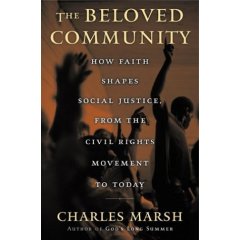
Charles Marsh's The Beloved Community is a gem. I was sold just on the content of the first two chapters (MLK and Clarence Jordan, two of my biggest heroes in the faith) , but I was moved by the rest of the stories in it as well. The theme of the book was the neccessary spiritual community that provided the spirit to drive the movement, a nd to keep grounded in true reconciliation that does not tire as "politics" ebb and flow.

Martin Luther King Jr. spoke of the "spiritual movement in Montgomery," Clarence Jordan of the "God movement" in southeast Georgia, Fannie Lou Hamer of the "New Kingdom in Mississippi," John Perkins of the "quiet revolution" of Christian community building, Mark Gornik of "the shalom of the city" together these Christians point us to the reality that stands behind beloved community and gives purpose to lifetimes spent in service to poor and excluded people, the reality that cuts through all these human movements as their hidden sense and motor.53These contemporary retrievals of the spiritual movement toward "redemption, reconciliation and die creation of beloved community" demonstrate the vital role of spiritual nourishment in the work of mercy and justice, not as a substitute for material sustenance but as the condition of justice.54 As Chris Rice said, "Communities like ours are hardly normative and they are never going to be normative, but their influence is disproportionate to their numbers. I just think of the hundreds and thousands of people who were touched through the work of Voice of Calvary in various ways: by coming and living with us for a while. These are places of deep conversion, places where the creation of allies is happening, places where Christians are learning not so much how to solve the race and other social problems but how to be truly church. I think there is lot of power in that. " 55 The civil rights movemerit had extended the gesture of reconciliation, only eventually to withdraw it in the face of hateful rejection; but the new Christian radicals are finding the strength to keep the arms of mercy open, even in the face of restitution shirked and due reparations withheld. 55- Chris Rice , presenting to the Workgroup on Theology and Race, U. Va. Feb 24, 2001.

p.206 Charles Marsh, The Beloved Community

I learned while on my DC trek that Gordon Cosby has been singing the praises of this book for the past few months. (I forgot to mention to him that I was reading it! ) But the Church of the Saviour and all its seedling churches have run on this principle;; on this reality. That behind every movement of true change there is a "God movement" that blows where it will, and gathers about itself a community of character, molded by the stirrings of God moving amongst them.

Perfectly Reasonable

| | Comments (1) | TrackBacks (0)

It's scary how easily it seems to be assumed that what the state syas it is doing, it is actually achieving. The "larger purpose"; the long-range, "real-world" matters are being taken care of by the magistrate, and it has become in our political climate

Only with the emergence of nation states, according to Giddens, are states circumscribed by borders, known lines demarcating the exclusive domain of sovereign power, especially its monopoly over the means of violence. Attempts to consolidate territory and assert sovereign control often brought about violent conflict. More importantly, borders in the nation state system include the assumption of a 'state of nature' existing between states which increases the possibility of war. Our fellow citizens are limited to all those presently living Britons, Americans, Germans, etc. The dominance of state soteriology has made it perfectly reasonable to drop cluster bombs on 'foreign' villages, and perfectly unreasonable to dispute 'religious' matters in public

Cavanuagh, Theopolitical Imagination, p. 43

There seems to be virtually no willingness to truly consider the lives of other people in other lands. All is presented to us as "neccessary for our security". "Security" is posed to us in terms of force, in terms of economics (another form of "force" or coercion), and in terms of "the way the world works". Violence is often justified as "this is the only language they understand" (which , when you look at it, seems to be proving that point about not the recipients of that violence, but of the ones using that justification.)

A simple "exchange program" where American families are transplanted into Iraq would dispel the myth of "over there" and that "behind the scenes" activity really doesn't affect us. A simple placing of "our own kind" in the jeopardy under which we have placed thousands of Iraqis would shed some light on just how much insanity we have consented to via our complicity (as a nation, and sadly, as a church).

Overcoming Opposition

| | Comments (4) | TrackBacks (0)

Eric commented on the post below that includes the section on Extreme Diversity. re-reading it once again, it is truly an important section of this striving to be and to embody authentic church.

Movable Theoblogical: The "Basics"

The world has told us that we are "opposed" to one another because of our differences, but this is an illusion. We are liberated as we come to know each other more deeply and are able to transcend the illusion of "opposites." Reconciliation requires finding common ground on which we can both transcend and embrace our differences. The authentic church provides that common ground.


The "pieces" that make a whole people are found scattered amongst us, it seems. This is what I gather from the message of the above. The idea that we cannot do it alone is to bring home the truth to us that we not only need companionship and support, but those "other" experiences that bring us closer to knowing all of God's family; all of God's people.

Finding Others

| | Comments (0)

The compelling desire to be with others in more authentic ways, ways that will foster diversity and reconciliation and help us to act for justice, often presses in on us long before we find others who share that desire. We can feel very alone. We long for something more, but don't know how to find others who might be willing to step out into new structures and processes with us.

You might be wondering where to start. That's easy: start where you are. Let the new way begin in you.

We can't expect others to internalize what we have not yet internalized ourselves. The first "other" we must be reconciled to is our own self. Our true self in Christ waits to know and be known by us. Are we in love yet with that beloved and broken child of God? Are we moving toward freedom from our own addictions? Are we actively seeking to reconcile our own broken relationships? Are we being honest about our own need for transformation, even as we ask God to bring others who are aware of theirs? Our first task is to confront ourselves lovingly and begin to surrender those attachments we cling to that keep us from clinging only to God.

And, of course, we need others. For starters, you have us. We will have conversation and find ways to support each other, even at a distance. We will share with each other how desperate we are for this --- how much we need and want recovery --- until we find that we are no longer satisfied with staying on the surface in any of our conversations. As we dare to speak more deeply with others, God opens doors to find those who also want something more.

What was it about Jesus that drew people to him? Primarily, they liked him. He treated them with respect; listening and confronting and speaking from his depths. When we are freed to be our true selves, our affection for each other will increase, and our conversations will take on a depth that we might not have imagined.

Yes, many of us have had the experience of being held hostage by a religious extrovert, and we might not want to be seen as one of "those Christians," but this is no excuse. We must be willing to take the risks of authentic friendship and compassionate connection, revealing ourselves for who we really are. Often these conversations become the way to discover who will be our companions on this journey.

FINDING OUR OPPOSITES

Finding those who are our so called "opposites," and talking about spiritual things, can feel even more intimidating. Basically we get tripped up by fear. We fear seeming arrogant and disrespectful. We fear being ridiculed. We fear being swallowed up by the pain of seeing so directly into the dismal face of poverty or privilege. We fear being paralyzed by our guilt over the discrepancies between us. These fears are legitimate and need to be felt. And then we must go anyway.

Our guiding question will be, where would Jesus go? Most of these places will be where the privileged and connected are the ones on the outside.

Look around your town or county. Where are people struggling for a better life? Where have people been abandoned? Where is the church absent? Find these places and go there. Don't go there to serve anyone. Don't volunteer to answer the phone or organize a clothing drive or teach reading or fix a meal. Don't do anything. Be. That's all. Learn how to hang out with people who are not like you. Hear their stories, and share something of yours. Be in the tension of not knowing for sure what to say or do. Relax and receive whatever God wants to give you. Learn to be present.

We will not be able to be the church that God intends if we don't let God plant in us, very simply, a passion for people. Not a coercive, codepenclent "love that's not love," but true affection that desires nothing else than to be there, and to be real. Crowds gathered around Jesus because he was available, and he was genuine. Who he was with them was who he was within himself. Are we living true to our inner selves? Are we the kind of people others enjoy being around? Do our schedules allow "hanging out time," and do we hang out where destitute, lonely people hang out?

The Church of the Saviour churches have always been open to diversity, Yet despite seeking welcoming ways to worship, pray, study and work together, most have not become fully diverse. We have had meaningful relationships with people of different races and economic classes, for example, and sometimes we also have been church members together, but generally we have not been a radically diverse and reconciling body at the foundations, with people of widely varying life experiences finding mutual partnership and belonging.

We have hoped that if we consciously sought to give ourselves to God and God's flow of love, reconciling and intimate relationships would happen naturally. By and large, however, they have not. This new process is an attempt to end our complicity in staying separated from each other and to build rich, mutual relationships with those from whom we have been isolated.

If we are going to be the church of Jesus Christ, true to his nature and part of God's redemptive plan for the world, we must find new ways to be together, ways that say, clearly and concretely from the outset, Yes, we are different from each other. We are of different races and cultures, some of us own very little and others of us own much; we have had different opportunities in our lives; there are ways in which we do not understand or trust each other, but we are family, and God has called us to be together.

We no longer wait untiI we have the "race issue" or the "economic issue" or the "power issue" figured out. We no longer will wait until we have a clear understanding of each other and feel completely at ease. Rather, our differences will be our starting place.

Will Sampson with a set of questions wondering how who I call the "Bush Christians" will begin to react to the now daily uncoverings of the pervasive scandals and manipulations of the Bush administration and its tentacles (the "tentacles" part I have added to the assesment, as well as the question about "holding out"----these are two things that occurred to me as I read Will's post) willzhead: Pastoring People Post-Bush

The cat is out of the bag. The secret has been let loose. President Bush is not an honest man. .... This current administration may go down as one of the most corrupt in history. Bill Clinton received sexual favors from an intern. Shame on him. But, to my knowledge, no one in his purview was responsible for using Christian radio to help further the business of Indian casinos and, in the process, pocket $45 million in lobbying fees.

I'm afraid that a good number of these Christians have hitched a disturbingly high amount of their theological well-being to this house of cards, and will die hard. Especially with Fox News in the mix, which is the only newscast most of them will even watch. They watch others and automatically dismiss any reports that cast the administration in a suspicious light to be part of the "liberal media conspiracy". It is all the more scary because we've seen in history debacles of how tenaciously church folks will cling to "righteousness" of a political cause against all evidence (Nazi Germany). (Once again, it's not comparing the magnitude of the evil, but the propensity for the "court prophets" (the "religious representatives" who provide the theological rationale for national interests as forwarded by the group in power. I must say however, that I can do something of a listing of the consequences of this administration which do catalog quite a distressing list of atrocities, but those shoujld be kept out of a context of "comparison" to Hitler and assessed on their own merits).

The point here is, is that "ideologies" die hard. But in the end, there is always that all-too elusive hope for a deeper harmony amongst God's people. We can't help but be saddened and disturbed when the call of the gospel is exchanged for "lesser", incomplete, even opposing loyalties; what Cavanaugh calls the "false soteriology" of the state.

Seeing Who We Are, and Whose We Are

| | Comments (0)

These items from "The Bascis", does indeed make a great group/church litany.

Movable Theoblogical

Together- None of us can become free alone. We will spend one hour together every week, sharing our struggles and joys.

And yet the church seems to be content to hand over the gift of ourselves and the gift that is us that God has set forth, and leave us to fend for ourselves against the culture. Of course they say "Go and God be with you", but what is missing is the embodiment of that litany. The idea is that the "Go" is to be set in the context of being "sent forth" from a people who form us and pray for us, and to do so, they have to know one another. So little effort , if any, is expended to stress the "alternative community" which makes "community" a living concept that goes beyond the stale, empty, "corporate" (as in corporations) notions of community. These latter notions hold out community as a "feel good" selling point so that people will hang around and be consumers and contributors.

Time- In the beginning, we will set aside at least 15 minutes a day for personal prayer and scripture reading, with the intent of getting to know Jesus and sensing how much God loves us. We also will commit to pray for each other

This is just for starters. This is a BARE minimum. But start someplace we must (kind of sounds like Yoda, doesn't it-----"Start someplace we must") but seriously, to "break in" to our routine with a much more "open-ended" possibility inherent in living in habitual seriousness with prayer and Scripture is so elemental that it is often totally ignored. And so we excuse ourselves on the assumption that such small portions cannot possibly work miracles. But I do think that such small doses draw us in and engage that hunger that lies often buried deep within, behind our busy facade that we place such emphasis and expend so much energy in maintaining.

Task- Jesus loves us deeply and passionately and calls us to give back to others. We will seek to find the task that God has for us to do. We want to be with those who are suffering and to help change the unjust structures that cause the suffering.

What a foreign concept that seems so clear and yet so neglected and avoided: that God calls us for a purpose at any given time, and continues to call us into new things. And again, it's not meant to happen out of community, and its meant to bring us into close contact with the broken and suffering. I'm reading a chapter right now in Marsh's The Beloved Community called Building Beloved Communities: Dispatches from the Quiet Revolution, which is a chapter that tells a story of several who have left what was surely more "successful" prsopects as our society holds them out, and placed their lot in community with struggling, wounded, seemingly hopeless and depressing communities. But what they found was what amounts to success as God defines it; that in casting our lot with the least of these, we find our deepest purposes, and discover the purposes for which we have been given gifts to offer, and we also discover the gift of "the other".

Take- We will take hold of Jesus, the Liberator, who tears us away from the worldly values and systems that bind and kill us. We will name those things in ourselves that keep us from living in a new way of nonviolent love and freedom, and offer them up for healing.

The bolded part, calling us to "Name those things" is a work of a lifetime. Elizabeth O'Connor explores much of this work of "naming those things" in her book "Our Many Selves", probably the most impactful book I have ever read. One reason for that is that I did it with some others. But the "goings-on" that we face in those battles we face within as we confront the "many selves" that show themselves in different contexts, which bring out the "unlovable" and "rejected selves" in us, and seek transformation for ourselves, in naming our "selves"; our many selves.

Tell- As we are being liberated and freed, we will tell others about the Source of our new freedom.

What other choice do we have? It's a ntural.

The "Basics"

| | Comments (1) | TrackBacks (1)

There aren't a lot of rules for how we function in these groups, but the following patterns have guided our time together:

We meet once a week for one hour.

Leadership rotates so that all who desire to do so will have the opportunity to lead. The leader begins the session on time and facilitates the sharing, often beginning with the principles and the affirmation in "The Challenge and the Hope" [see Appendix 1).

One member, sometimes the leader, serves as teacher and speaks for five or six minutes, usually focusing on one of the five steps and a passage of scripture.

Approximately 45 minutes are given to personal sharing. This sharing, which is the heart of the meeting, is not about ideas but feelings, not conjecture but experience.

Confidentiality is honored. What we say in the group stays in the group.

Generally we follow the 12 step method of attentively listening to what is shared with no response or cross talk.

The leader facilitates prayer at the close of the time, and in some groups a member celebrates the Eucharist.

Group business items are considered at a separate time, as needed.

BECOMING A MEMBER

Becoming a member of this initial group is very simple. We want all to know how much each person is wanted and needed, and how much everyone's participation benefits the whole.

Becoming a full member of the group requires three steps:

At the invitation of a current member, attend two consecutive meetings and indicate a desire to belong.

Be willing to embrace the basic principles named in "The Challenge and the Hope" [see Appendix 11.

Commit to the principles and practices of the five steps, and be willing to share personal experiences and feelings openly and honestly, respecting the confidentiality of the group.

ENDING ONE'S MEMBERSHIP

Ending one's membership in the group is equally simple:

Be absent from two consecutive meetings without notice.

Indicate a desire to withdraw, preferably after prior discussion with the group.

EXTREME DIVERSITY

From the beginning, these groups have been an experiment in extreme diversity, intentionally bringing together seeming "opposites," people who appear outwardly to have little in common with each other and who might not otherwise be likely to find depth belonging together. In overt ways racially, culturally, economically, etc. we are different from each other, and often separated because of these differences. By joining the group we are saying we want to know and be known by others who seem different from us and to offer these seeming differences as a healing gift for the whole.

We intentionally work to maintain a balance of diversity because we want to embody Jesus' nature, and we know Jesus expresses himself through all parts of God's family, reconciling all who are separated. That's just who Jesus is. If we hope to be healed from our isolation and be made whole again, we will seek to reunite with all from whom we have been separated. We therefore seek mutual relationships with our so called opposites. Not to "do for" but simply to "be with" one another. We long for God to heal and redeem what has been broken between us.

To have the desired diversity means that although we believe the life changing love of Christ is available to all, we will guide people toward groups where their presence will more likely complement the balance. Also, we no longer hope that our "opposites" will seek us out and discover how welcoming we are; instead, we will notice who is not represented in our group and accept personal responsibility for inviting them in. We will extend ourselves to others whom we might not have sought to know before. We will ask, who is not represented here and what would need to happen to create a more diverse body?

In a group that is small enough for in depth sharing (probably a maximum of about 20, splitting off into new groups when the number grows larger) it is nearly impossible for all variations of diversity to be represented, but we are committed to making concerted effort to have as much diversity as possible.

Extreme diversity is essential if we are going to become the authentic church, but it does not come to most of us naturally. Our natural gravitation tends to be toward sameness. We want to be intentional about breaking this ingrained pattern. We are inspired by Jesus, who was always crossing the cultural boundaries of his day. He sought to break through walls of separation and injustice, and so shall we. Joined in that desire, we will, as Gandhi said, "become the change we hope to see in the world."

We all are damaged by the ways we have isolated ourselves, trying to avoid being known. Determined to protect ourselves and play it safe, or be as independent as possible, we have adopted various attitudes and behaviors as pathetic substitutes for the holy. We need each other , especially those whom we have hurt and have been hurt by, if we hope to be healed. Letting down our walls and learning to care for each other is the way we begin to find the healing we so desperately need.

The world has told us that we are "opposed" to one another because of our differences, but this is an illusion. We are liberated as we come to know each other more deeply and are able to transcend the illusion of "opposites." Reconciliation requires finding common ground on which we can both transcend and embrace our differences. The authentic church provides that common ground.
Josh Marshall has a few choice words for the Disaster readiness consultancy firm Michael Brown is starting.

Talking Points Memo: by Joshua Micah Marshall: November 20, 2005 - November 26, 2005 Archives

First , from an AP article:

Brown said officials need to "take inventory" of what's going on in a disaster to be able to answer questions to avoid appearing unaware of how serious a situation is.

In the aftermath of the hurricane, critics complained about Brown's lack of formal emergency management experience and e-mails that later surfaced showed him as out of touch with the extent of the devastation.

Then Josh, from TPM

This guy's really a Bush man through and through, ain't he?

It's important to keep close tabs on everything going on in your disaster so as to avoid the true catastrophe of having the press think you're not on top of things.

It's good to see that getting knocked around last Fall helped get his priorities straight.

In Josh's previous post on the news of Brown's intentions, Brown said this::
Talking Points Memo: by Joshua Micah Marshall: November 20, 2005 - November 26, 2005 Archives

"You have to do it with candor. To do it otherwise gives you no credibility. I think people are curious: 'My gosh, what was it like? The media just really beat you up. You made mistakes. I don't want to be in that situation. How do I avoid that?'"

And this service is going to in demand by who? The fact that Brown was so woefully unprepared and unarmed with bare facts about the disaster is going to be something which makes people line up at his door to find out how he did it? As Josh says, it seems that the key thing here is not to APPEAR incompetent. But even there, we're supposed to learn from someone who failed miserably at that as well? I have a suggestion for anyone who wants to "spin" appearances: get it handled on Fox News. Maybe Fox News should hire him. He can do a show with Ollie North.

What's The Plan?

| | Comments (0) | TrackBacks (1)

KEEP IT SIMPLE

The greatest challenge for most of us who want to go deeper spiritually, and to do so in community, is to find ways that are simple enough to hold the complexity.

Just as Jesus is a gate where the sheep can come in and go out and find pasture [John 10:7 9], we too want to be a gate through which people can come in and go out with ease. We want to make concrete for others the openness and breadth of Jesus' way, as welI as its yet to be discovered treasures. The authentic church will hold the tension between easy and difficult, broad and narrow.

We want processes for this introductory group that are simple enough to enter easily, yet hold the potential of leading us into the untold depths of Christ. We want to be flexible enough to allow the Spirit room to play and yet sturdy enough to hold up under the pressures that inevitably will come.

A FIVE STEP PROGRAM

We have chosen to begin with a simple five step program. The processes of other groups might be different. Changes can be made freely as each group is guided to do so, but we suggest that they be made toward greater simplicity, not greater complexity.

Just as we have tried to keep this little guidebook as simple as possible (while assuming that most readers are familiar with "church language"), it is important to be as straightforward and plain as possible when we share the purposes and hopes of this group.

The following, which some of the groups use as part of a unison litany, states our intentions in language that we hope will speak to all, with or without overtly "religious" experience.

Together
- None of us can become free alone. We will spend one hour together every week, sharing our struggles and joys.

Time In the beginning, we will set aside at least 15 minutes a day for personal prayer and scripture reading, with the intent of getting to know Jesus and sensing how much God loves us. We also will commit to pray for each other,

Task Jesus loves us deeply and passionately and calls us to give back to others. We will seek to find the task that God has for us to do. We want to be with those who are suffering and to help change the unjust structures that cause the suffering.

Take We will take hold of Jesus, the Liberator, who tears us away from the worldly values and systems that bind and kill us. We will name those things in ourselves that keep us from living in a new way of nonviolent love and freedom, and offer them up for healing.

Tell As we are being liberated and freed, we will tell others about the Source of our new freedom.

Family Portrait

| | Comments (2)

Family2002a.jpg
This was almost 3 years ago, but one of the best of myself I could find (I'm usually behind the camera). Brian is taller than me now. How time flies and kids grow!

Wife Janet and Son Brian

| | Comments (0)

janet_brian_rockies_04.jpg
Also durijng that October 2004 trip to the Rockies

Bush Joking? Probably NOT

| | Comments (1) | TrackBacks (0)

Juan Cole reflects on the Bush-Aljazeera relationship, and why he doubts that Bush was "joking"

Informed Comment

Despite attempts of British officials to muddy the waters by suggesting that Bush was joking, another official who had seen the memo insisted, "Bush was deadly serious, as was Blair. That much is absolutely clear from the language used by both men."

Not long ago I saw a documentary Control Room, about Aljazeera, and prominently featured Josh Rushing, who worked in the U.S. Central Command Media Office. Excellent film, by the way. The death of the journalist menti oned by Cole actually happens during the filming (not on tape, but during a shoot, when the cameras were not rolling....since they were taking cover)

Just a Vocal Portion

| | Comments (0) | TrackBacks (0)

The Christian Blogosphere: what some in it are currently saying about Iraq | blogs4God

Of course neither my view or the views held in the above link represent the Christian blogosphere in it's entirety - just a vocal portion of it.

Of course. Of course, also, these "vocal voices" are not at all representative of those who are vocal (me for instance, or an entire contingent of thousands who agree with Jim Wallis that the Religiour Right does not speak for all Christians. But that whole issue is effectively sidestepped and ignored in so many of the "sub-blogospheres" purporting to represent "God-centered Blogs". I posted on this yesterday, and got comnments back and an email saying "You're welcome to post anything you want here, as long as its civil". I commented back and said something to the effect of "I thought Blogs4God was an aggregator and "summary" type of blog portal, and for over a year, you were linking to articles of mine with regularity. Since the election season and my voicing of sharp criticisms and concerns about the Bush administration, it's like I've dropped off the radar. I said I didn't really plan on c oming over to Blogs4God and post comments there. I expect, as always, to post what I belive to be pressing questions and rant on these questions for a time. I expect that since we all have blogs, that anyone can post rebuttals. I want to avoid comment section wars of words, which is what I expect will happen inevitably if I post my viiews there, but blogs can certainly be distributed conversation, and so I prefer to wait and see if this whole issue is considered woirthy of mention as Blogs4God summarizes the "interesting posts of the day". And of course, I'm not going to censor any comments that may be entered on my blog either. If anyone wants a debate about peace and Iraq and such, then we'll have one.

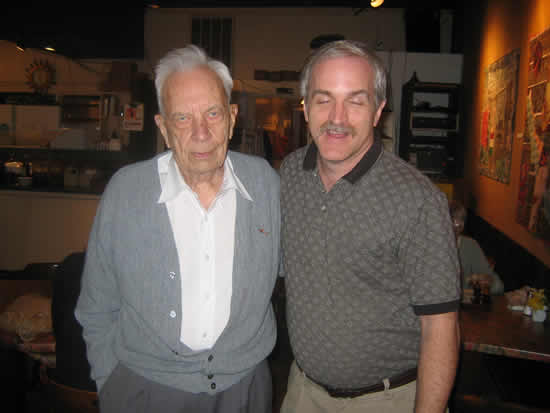
A Pic With Gordon Cosby

| | Comments (2)

MeWithGordon.jpg
Someone took this picture for me, but the camera took so long to actually take the picture, that I got caught with my eyes closed, and Gordon quit smiling, but ......well, there it is.

Second VideoPodcast

| | Comments (5)

Brian and Kelli

| | Comments (2)

Brain_Kelli_Smokies04.jpg
During our trip up the mountain in the Smokie Mountain National Park, October 2004

Some pics of the family to show off

| | Comments (5)

kelli0505.jpg
This is Kelli, 7 1/2 years old

Whom to Subsidize

| | Comments (0) | TrackBacks (0)

Thunder Jones has a good post on how what amounts to subsidies for high-tech (focused on military) could better be used in subsidizing health care, which will help businesses who are going under and strugging becuase they can' afford it anymore.

The Mundane Life of Thunder Jones: Choosing Your Subsidy


It is true that the military subsidy has helped to create the consumer microchip, the internet, and modern aviation. It hasn't been all bad. Then again, we've essentially been subsidizing the ability to dominate the other via violence or the threat of violence. Subsidizing healthcare will create advances in medicine as well as providing for the common good. I choose healthcare.

First Video Podcast

| | Comments (3) | TrackBacks (0)

Movable Theoblogical: Addiction to Culture, In Need of Redemption
I just put up my very first VideoPodcast. It starts out cutting Gordon Cosby's head out of the frame (sorry, badly placed camera.....it was taken with my Canon A80 in AVI mode. It goes with the post in the above link.

See Flash Video of part of my conversation with Gordon Cosby, where he covers some of this , referring to the latest thinking of theirs on the way their support groups work

On the Way to Rolling Ridge

| | Comments (0)

onthewayRR.jpg
Some more scenery near Rolling Ridge, where I spent some time last week.

IE won't show one particular image

| | Comments (0)

I have an image, http://theoblogical.org/movtyp/images/AuthChurch.jpg, that shows up to the left of tghe post below, but only in Firefox and Netscape. IE won't show it, although it is no problem with the rest of the images on the page. Anybody know what could possibly cause this? If you take the img url above and plug it in to IE to browse to it, it shows up fine. But not in those blocks to the left of my Authntic Church posts. ???????

What's up with that? IE is being way too wierd.

This is crucial to get hold of:

WE ARE CULTURAL ADDICTS AND WE CANNOT BREAK THIS ADDICTION ALONE.

Finally seeing this truth really "getting it" that we are addicted to the very culture and the very way in which we live is the beginning of true freedom.

When we "wake up" to the fact that we have been distorted as human beings by the culture; that we have been "drugged" on a chemical which is culture, and are very much like the addict who is hooked on alcohol, then we see the need for a community whose narrative is wholly different from that in which we have been intoxicated. We have to "detox" from the culture of individualism and violence.

When we finally see that we are addicted to a culture of comfort, security, competition, praise, staying busy, controlling people, being in shallow relationships, having too much or too little money, worrying, seeing ourselves as superior or inferior to others that a vast assortment of sensations, behaviors, substances and activities keep us disconnected from our real feelings and needs and disconnected from God we can then unmask the false nature of this cultural system and see that it can never give us what we long for. We will be able to see at last how much we have depended on this false system, and how utterly helpless we are to break our dependence and to heal ourselves.

Then, together with every alcoholic or drug addict who has hit bottom and cried out for help, we too will cry out for a Saviour and for a faithful community to save us from our cultural addiction. At this point, humbled and ready to receive mercy and healing love, we see the truth and commit ourselves to becoming recovering cultural addicts and to being used by God in whatever ways God chooses.

See Flash Video of part of my conversation with Gordon Cosby, where he covers some of this , referring to the latest thinking of theirs on the way their support groups work

Blogs 4 God Still Silent

| | Comments (9) | TrackBacks (0)

A while back, I posted something like "Blogs 4 God has ditched me", and not soon after, I got an email from someone there saying, "NO we didn't". My observation back then was that since the election season, and ever since, there has been ZERO linkage to me other than the lone listing I have there. Before the Election season and all its issues, on which I coimmented regularly and often as to my opinion of the Bush administration, there were pointers to my blog on a fairly regular basis. Since then, and even after the denial of that charge, still NOTHING. It's not that I even want them pointing to me if it means what I think it means: that they would do so in the context of disagreement. Perhaps that is why they DON'T point to me any more. IN that case, that's fine. I really don't want to attract any "trolls" from the ranks of those who consider it tantamount to blasphemy to criticize the Bush administration.

But it also seems to me to be another instance of "ghetto-ization" of many such "Christian" blogdoms, and it seemed so at the GodBlogCon as it seemed quite heavy if not exclusively Pro-Bush Pundity bloggers. I know that such is so with LeShawn Barber and Hugh Hewitt.

I saw the general makeup of Blogs4God when I signed up, but wanting to be ecumenical, I joined. And prior to the election season and all my theologizing about the Bush administration, Blogs4God regularly linked to my posts. I understand that they may well have a few more "godBlogs" in their aggregation tasks now, but to fall to ZERO menti on?

It's even more disturbing that this "political" marginalization has happend considering that I have made a complete U-turn in terms of theological-to-political rant ratio. Much of my blog has been centered on church and the need to Authentic church. Prior to my trip to DC, I wias reading heavily in Radical Orthodoxy writings, via Stanley Hauerwas and James KA Smith, William Cavanaugh, etc. It would SEEM that such things might be of interest to "God bloggers". I'm not quite sure now what the criteria is for selecting links.

Just as the Southern Baptist convention, ala the likes of Al Mohler, have basically narrowed the scope of theological inquiry to their choice topics and issues, and "cut off" discussion (Mohler has no comments on his blog), and NEVER talks about the Bush administration's war policies ----I mean, completely ignores it-----it seems that opposition to war and to Bush is also anathema to Blogs4God. And that is extremely sad. They (the "keepers" of Blogs4God, don't have to agree, but if they are going to purport to represent the totality of "Blogs that explore the things of God" , then a huge contingency is missing from their "coverage".

From what I read of the GodBlogCon, the "featyured" attenders and "linked" reviewers and "name-dropped" people are all pretty rabidly right wing (except for DJ, with whom I am familiar from past blog comments and blogger meetups----plus DJs being a rep of American Bible Society brings a certain "ecumeniucity" to the "right-heavy" leanings of GodBlogCon.

The "First Impressions" list at http://www.godblogcon.com/blog/ are batting 1.000 for total absorption in the right-leaning blogosphere, seemingly oblivious to the fact that there even exists things like Progressive Chritian bloggers, or anything "other" than , well......Why was that?

This all bothers me.

What's Stopping Us?

| | Comments (0)

If we can name and embrace what, for us, are the "givens" of being authentic church, and we know we want something more, and we even are willing to let go of old traditions and structures, what keeps us from embodying the new? We see who Jesus is, and genuinely believe that his way is the way for us, but are unable to live that way fully and passionately. We long for Jesus' nature, but we seem to be trapped by our own nature and unable to break free. What causes this disconnect in what we want to do and what we actually do?

The answer is quite simple. We have not yet faced one basic and inescapable fact:

WE ARE CULTURAL ADDICTS AND WE CANNOT BREAK THIS ADDICTION ALONE.

Finally seeing this truth really "getting it" that we are addicted to the very culture and the very way in which we live is the beginning of true freedom. [To begin to learn more about cultural addiction, see Appendix 3, Resources "Facing Our Cultural Addictions,' p. 47.]

When we finally see that we are addicted to a culture of comfort, security, competition, praise, staying busy, controlling people, being in shallow relationships, having too much or too little money, worrying, seeing ourselves as superior or inferior to others that a vast assortment of sensations, behaviors, substances and activities keep us disconnected from our real feelings and needs and disconnected from God we can then unmask the false nature of this cultural system and see that it can never give us what we long for. We will be able to see at last how much we have depended on this false system, and how utterly helpless we are to break our dependence and to heal ourselves.

Then, together with every alcoholic or drug addict who has hit bottom and cried out for help, we too will cry out for a Saviour and for a faithful community to save us from our cultural addiction. At this point, humbled and ready to receive mercy and healing love, we see the truth and commit ourselves to becoming recovering cultural addicts and to being used by God in whatever ways God chooses.

From the deepest parts of us we now understand that we can no longer pretend that everything is fine and we can manage our lives alone. We must join ourselves with others for our mutual healing and transformation. We need others who are equally serious about taking hold of the liberating Christ. We need ...

  • a group, in Christ, that is breaking with the culture, the world's systems, and providing support for total recovery from that culture
  • a reconciling group of extreme diversity, especially highly privileged and severely oppressed
  • a group closing the gap between the deepening of personal faith and the expression of that faith in public political ways
  • a group seeking biblical justice in all forms, including the redistribution of wealth
  • a praying group, growing in our capacity to love, understanding that authentic love is always nonviolent.
    I Knowing that we are cultural addicts and need an authentic community for our recovery ...

More Mountain Scenery

| | Comments (1)

DCwvaMountains1.jpg
JUst a little scenery to end my blog day and the day in general, from my collecgtion of stuff shot during my DC/Virginia/WestVirginia driving last week. This was on the way from Rolling Ridge near Harpers Ferry, WV down to DC, somehwere near the WVa/Virginia state line along the panhandle of Wva.

JVC Camcorder

| | Comments (0)

My DV Camcorder which I got in 2000 has had periodic problems with the apparently infamous "E04 error: Unit in Safeguard Mode" problem after about 2 years of my 3 year warranty. I got it back to have it "serviced". Didn't see the error much after that for about a couple of months. Now it's back and happening with regularity almost everytime I try to use it. Usually "Remove the battery and re-attach" by itself doesn't work. I have to remove the tape, remove battery, re-attach battery, re-insert tape" and various combinations of that. BUt the error happens also when I am running from the AC Adapter.

A search like this reveals that this problem is rampant across JVC DV "GR" model camcorders. I tried the "smack it 4 or 5 times with the battery over the speaker area --which is on the side inside where the flip-out LCD screen opens. Mine seems to work after doing that. This I find after taking it with me to DC and having it refuse to work when trying to use it to shoot some mountain scenery on my way in to the DC area. I wish I had known then about the "whack it upside the speaker" trick. I had to settle for shooting Video with my Canon Digital Photo camera that shoots low quality, small size video avi clips of 3 minutes max.

In any case, I was looking at the new models, about to try to get a replacement (whcih I was loathe to do, but Thanksgiving and Christmas is coming up, so my wife asked me to see what we could get....then I decied to do this Google search. Really wierd)

On the Fake Resolution

| | Comments (0) | TrackBacks (0)

Juan Cole explains the manipulative Republicans' adolescent call for what amounts to a vote on a straw-dog: their version of a resoltion that in no way resembled what Murtha actually suggested (except that it had to do with the subject of Withdrawal from Iraq). There's where the similarity ends.

Informed Comment

Republicans in Congress responded to Murtha's considered plan by introducing a phony resolution the bore little resemblance to Murtha's, and then helping defeat it overwhelmingly. The intent was apparently to force the Democrats either to look as though they were in favor of "cutting and running" or to vote against immediately withdrawing US troops and so associating themselves with Bush's 'stay the course' policy. The Republican straw man resolution was:


' Expressing the sense of the House of Representatives that the deployment of United States forces in Iraq be terminated immediately.

1 Resolved, That it is the sense of the House of Representatives that the deployment of United States forces in Iraq be terminated immediately. '

Well, this stupid resolution is not what Murtha was saying, and the vote on it is meaningless. It is worse than meaningless. It is political clowning.

From INformed Comment: Informed Comment

At the Iraqi national reconciliation summit, the Shiite delegation of the Supreme Council for Islamic Revolution in Iraq walked out when a Christian Iraqi implied that they were traitors and puppets of the US and alleged that the new Iraqi consitution was written by the Americs. The delegation only returned to the table when it received an apology from their hosts and a pledge that the Christian delegate would be prevented from "abusing the platform."

I'd like to find out a bit more on who that person was

OK! I'm almost there on the customization of the look for certain Categories.
In this post earlier, Eric and Dave offered help. The links Dave pointed to were the easiest solution for my feeble MT mind to grasp. Worked like a charm. Eric had helped me before figure out where to put the css change for the blockquote , which I had applied at one time but since moving to StyleCatcher and its "dual" stylesheets (where styles-site.css imports two stylesheets. I guess I could add the mt IfCategory tag in the template file, just after the css call, as a condition to pull in a particular css file AFTER that so that its settings override any previously set styles? Am I on the right track?

For example, right now, styles-site.css has this:

/* This is the StyleCatcher theme addition. Do not remove this block. */
@import url(/movtyp/mt-static/themes/base-weblog.css);
@import url(/movtyp/mt-static/themes/theme-theoblogicalOld/theme-theoblogicalOld.css);
/* end StyleCatcher imports */
.AuthenticChurch {
padding: 10px 10px 10px 10px;
background-color: #effbdb;
border: solid 1px #7c9e40;
}

I added the special section for AuthenticChurch below it based on this link's suggestion

If I then do this:
Then in your Main Index template, add the div class
<div class="<$MTEntryCategory$>">
just after the MTEntries tag. Close the tag by adding a </div> before the closing MTEntries tag.

then I should see the .AuthenticChurch class get called. Let's try it.

Update: 9:48pm It all works.

Authentic Church: Our Evolving Story

| | Comments (0)

Some have been asking, what about the earlier model of The Church of the Saviour? Isn't it a good enough way to be in meaningful community with others? As some of us have been exploring this different way of coming together, one thing we have discovered is that this supposedly "new" model is actually a very natural evolution of the "old" model that we've tried to embody faithfully for nearly 58 years.

We have always tried to follow the authentic Jesus, and to do so in small committed groups of people who are intentionally on an inward journey with God and one another and an outward journey with those who have been excluded, who are "other."
We have been richly blessed by God, and yet when we look at our own churches we wonder, have we truly embodied the full, diverse nature of Jesus Christ? Have we impacted our society on behalf of the oppressed, challenging and changing systems that keep some outside? Have we become what God intended?

Sometimes we become so focused on sustaining what we've been given and wanting to honor the traditions of the past that we miss the new thing that God might be trying to do today, something that will build on all that has come before. We miss the surprises that lie in store for us. To be channels of that playful Spirit of eternal newness, we must always be ready to let go of what is in order to receive what will be. We must be ready to return to what is fundamental.

As long ago as 1963, Elizabeth O'Connor wrote in Call to Commitment that people were questioning why The Church of the Saviour was changing its structures. This is how she responded:


We never have expected to hit upon that final stable structure. This is important for a church to understand, for when it starts to be the church it will constantly be adventuring out into places where there are no tried and tested ways. If the church in our day has few prophetic voices to sound above the noises of the street, perhaps in large part it is because the pioneering spirit has become foreign to it. It shows little willingness to explore new ways. Where it does it has often been called an experiment. We would say that the church of Christ is never an experiment, but wherever that church is true to its mission it will be experimenting, pioneering, blazing new paths, seeking how to speak the reconciling Word of God to its own age, It cannot do this if it is held captive by the structures of another day or is slave to its own structures.

We must never let ourselves be held captive by the structures or traditions of any institution, including our own. We must be open to being given new structures and new methods that will serve the mission of Christ even better for this new time.

To be in the flow of God's ever evolving movement, we will transcend all traditional and institutional loyalties, including loyalties to the very institutions we ourselves brought into being. We will adventure out into places where there are no tried and tested ways and be ready to experiment and pioneer and blaze new paths in order to make the news of our extravagantly loving liberating, reconciling God real to this age.

The Potter's House

| | Comments (0)

pottersHouse.jpg
The coffeehouse/bookstore of The Church of the Saviour